
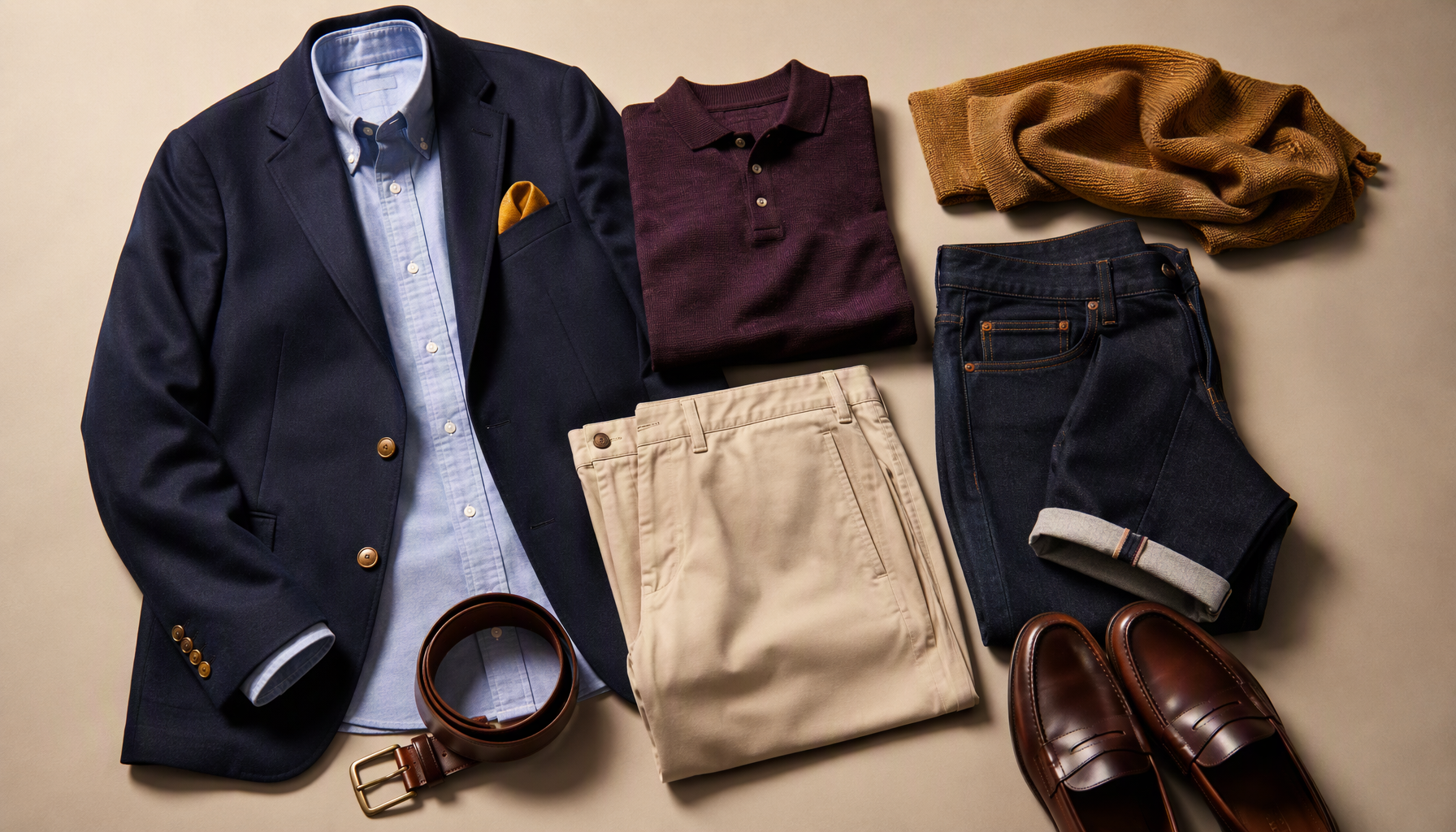
Men’s business casual is not one fixed uniform. Use the workplace, role, client contact, season, commute, and actual dress code to decide how much structure and polish you need.
Gear’s decision lens: The decision here is about finding the middle between formal businesswear and casual clothing while keeping fit, movement, care, and repeat use practical. Read how Gear researches guides and review the affiliate disclosure.
Men’s business casual outfits can include shirts, polos, knitwear, chinos, trousers, loafers, clean sneakers where allowed, jackets, and practical layers. The workplace determines the boundary.
What Is Men’s Business Casual? A Practical Buying Guide: Quick Decision Guide
Imagine You Are…
You are starting a new job where some people wear button-down shirts and others wear knit polos or clean sneakers. You need a first-week wardrobe that looks prepared without buying a completely formal uniform.
Start with the actual use case, then compare fit, maintenance, movement, and return risk. Start with the use case, then narrow the formality, fit, maintenance, and return risk.
Gear uses available evidence for this specific decision and identifies what remains uncertain. Men’s business casual changes across corporate, creative, client-facing, hybrid, service, and trade workplaces. The guide does not present marketplace information as direct product examination.
Decision Matrix
Last checked: October 4, 2026
Keyword demand can help prioritize a question, but it cannot prove fit, comfort, durability, or event suitability. Verify the live product and venue information before ordering.
Commercial boundary: This guide is informational and contains no affiliate product links. Commercial Gear comparison pages disclose relationships separately; this article focuses on the priority is the right level of structure for the real workplace, supported by fit, shoes, layers, and condition..
| Situation | Decision lane | Useful starting point | Watch-out |
|---|---|---|---|
| Conservative office | Higher structure | Collared shirt, tailored trouser, loafer, restrained layer | Confirm the actual workplace before buying heavily |
| Creative office | Relaxed polish | Knit, overshirt, trouser, clean sneaker where allowed | Personal detail should not replace fit |
| Client-facing role | Presentation plus comfort | Reliable tailored base and polished shoe | Client expectations can vary by meeting |
| Hybrid work | Camera and commute | Clear upper half, comfortable base, practical layer | Test the outfit on and off camera |

Choose the Path That Fits Your Situation
The new starter
Choose this path: Begin slightly more polished and observe the workplace.
Watch-out: do not buy a complete wardrobe before learning the dress code.
The client-facing professional
Choose this path: Use a reliable tailored base and polished shoe.
Watch-out: comfort and commute still affect performance.
The creative-office dresser
Choose this path: Use relaxed shapes with clean condition and intentional proportion.
Watch-out: casual does not mean unconsidered.
Read the workplace rather than the internet
Business casual means different things across finance, technology, education, healthcare, creative offices, retail, and client-facing work. Look at employee photos, ask a contact, or use the first week to observe before expanding the wardrobe.
When uncertain, begin one step more polished and simplify after you understand the environment. A jacket can come off, while an overly casual outfit may be harder to adjust once you arrive.
Build the base outfit
A useful base may be a collared shirt, knit polo, clean sweater, chinos, tailored trousers, loafers, boots, or a minimal sneaker where the workplace allows it. Fit and condition matter more than brand.
Check proportions together. A relaxed shirt with a slim trouser, a structured jacket with very casual shoes, or a cropped layer can change the formality. Look at the full outfit rather than rating each piece alone.
Use shoes and layers to set formality
Shoes often establish the boundary. Loafers, derbies, clean boots, and simple sneakers can signal different levels of formality. A blazer, overshirt, cardigan, or jacket can also move an outfit through the week.
Care is visible. Scuffed shoes, wrinkled layers, pilling, or worn collars can change the impression even when the outfit is technically appropriate. Build maintenance into the buying decision.
Handle color and season
Neutral bases are easy to combine, but business casual does not need to be colourless. Use texture, muted color, seasonal weight, and one accent to keep the outfit useful without becoming loud.
Weather and commute should influence fabric, layer weight, and shoe choice. An outfit that looks good in an office photograph may fail on a hot train, rainy walk, or cold lobby.
Before You Commit
- Identify the workplace and client expectations.
- Choose a base outfit before accessories.
- Use shoes and layers to adjust formality.
- Check fit, condition, care, and season weight.
- Observe before expanding the wardrobe.
The priority is the right level of structure for the real workplace, supported by fit, shoes, layers, and condition. The most useful final check is the one that prevents the likely failure in this situation, whether that is wrong formality, poor movement, missing weather protection, unclear fit, or unnecessary care.
Frequently Asked Questions
What counts as men’s business casual?
It depends on the workplace, but often includes polished shirts or knitwear, chinos or trousers, suitable shoes, and a clean layer where appropriate.
Can men wear jeans for business casual?
Sometimes. The workplace, denim color, condition, fit, and what it is paired with determine whether jeans are appropriate.
Are sneakers business casual?
Some workplaces allow clean, simple sneakers, while others do not. Check the actual office context rather than relying on a universal rule.
How should business-casual clothes fit?
They should allow sitting, walking, reaching, and layering without constant adjustment. Compare measurements with a garment you already own.
Does Gear test business-casual clothing?
No. Gear uses available product evidence and explains limitations.
More Gear Decision Guides
- Match the guide to the actual occasion, routine, or wardrobe gap.
- Check fit, care, weather, movement, and return risk before ordering.
- Use the mens style buying guides hub for related guides.